


It's a familiar cycle: Healthcare costs rise. High-dollar claims follow.
And self-funded employers pay more than ever to protect themselves from both.
In 2025, 49% of respondents to the Aegis Risk Medical Stop-Loss Premium survey had at least one $1-million-plus claim. At the same time, Tokio Marine reports the frequency of $2-million claims has increased 213% since 2020.
As a result, today's employers are expected to pay on average 14.5% more for their stop loss premiums in 2027, a heavy burden for those also facing a 9% increase in overall medical costs.
But what's driving the increase in these high-cost claims — and is there anything self-funded employers can do to minimize their financial risk when it comes to associated stop loss premiums?
We sat down with Beth Madden, Executive VP of Stop Loss Programs at Vālenz Health®, to tackle exactly that topic. Below, learn more about the industry trends affecting our employer clients this renewal season, including our team’s recommendations for achieving smarter stop loss policy design through strategic cost-containment efforts.
What's Driving High Renewal Prices in 2027
For many stop loss carriers, the challenges of today's market can boil down to an increasing share of risk.
Medical stop-loss loss ratios have climbed significantly in recent years, reaching 86% industry-wide in 2024 — an "unsustainable" number, according to Madden.
"Part of the reason that we’re in the situation that we’re in today is that the market pressures have not required a plan to take more risk for a lower cost," said Madden. "They can get the lower cost and keep the same risk threshold. That’s put the stop-loss carrier at a disproportionate share of the risk."
As a result, many carriers are accounting for that higher risk through higher renewal premiums, meant to offset the financial pressures of:
- Underlying inflation across the healthcare industry
- New services and products, including AI-enabled technology
- An aging workforce causing increased care utilization
- Higher provider reimbursements caused by increased labor costs, outdated contracts, regulatory issues such as the No Surprises Act, etc.
While all of these play a role in skyrocketing costs for employers and carriers, two categories of care frequently top the list of high-priced stop loss claims: gene cell therapies and GLP-1 weight loss medications.
Gene Cell Therapies
By 2034, the global cell and gene therapy (GCT) market is set to reach $75 billion, an expected increase of 27.94% from 2024. In the meantime, these growing pains are borne by today’s health plans, with GCT drugs used primarily for cancer treatment making up 80% of the top 10 highest-cost drugs in stop loss claims.
Even a single high-cost drug claim can blow up a stop loss policy, driving up overall plan costs significantly, said Madden.
"It's definitely an unusual problem, because the incidence is extremely low," she said. "These are orphan conditions and drugs that have come to the market, but the severity can be extraordinary. We're talking about $3 million, $4 million, $8 million treatments seen by some of the largest carriers."
The rarity of these cases — especially in covered populations with no history of them — means today's carriers often cannot accurately prepare the risk profile for a policy. While most carriers cover gene cell therapies under traditional stop loss policies, some require plans to buy excess coverage, passing higher rates to employers and causing a hardening of the market.
"It's very difficult to price when it's concentrated on one member of the plan," said Madden. "If you brought [gene cell therapy] to me as an underwriter and said you were carving it out, I would have to tell you I can’t give you much of a discount for that because, again, those are very low frequency but high severity, and it’s just hitting my whole block."
GLP-1s
For many health plans, GLP-1s have become the single largest driver of drug spend, with popular brands costing more than $12,000 a year per patient. And, with their potential to treat other conditions besides obesity and diabetes, the financial challenge to health plans is likely only to grow.
“Any of my underwriters would tell me that these drugs would be in the top five of every single case they see,” said Madden. “I’m not talking every other case. I’m not talking every third case. I’m talking about every case they see.”
While health plans can set strict requirements for GLP-1 prescription coverage (such as clinical diagnosis criteria and supplementary lifestyle coaching), the ease with which members can obtain a prescription via telehealth providers can still put an unexpected burden on payers, even those with stop loss protection.
“We have definitely seen aggregate claims this year where 5% of the total claims were on GLP-1s that were not tied to an approved indication for that member,” said Madden. “People are probably going to get it off label if your plan design doesn’t have it. They’re going to get it for the wrong diagnosis or the wrong reasons.
"You're not going to see those health benefits, but you are going to pay for it in the claims. You're going to pay for it in the underwriting, too."
That said, because of their potential in treating common chronic diseases, covering GLP-1s may end up being a successful strategy for health plans in the long run. Clinical research shows that certain GLP-1s therapies can improve quality of life for patients with obesity-related heart failure, lower blood pressure, and reduce the risks of serious cardiovascular events — opportunities to improve long-term health outcomes and related expenses over time.
Health plans and payers should seriously consider these benefits while writing GLP-1 coverage into a plan policy, as well as work with their stop loss carrier to see which discounts may be available for GLP-1 coverage as a proactive cost-containment program.
“If I’m a broker or an advisor, I’m kind of keeping that in my back pocket; my plan is paying for [GLP-1s] upfront,” said Madden. “I’m hoping that the data is going to show me three years from now that I have less diabetics, less dialysis claims, less cardio claims — be able to show value for the spend.”
Influencing Your Stop Loss Renewal Pricing
While higher stop loss premiums will be unavoidable for many self-funded health plans this year, employers and payers can still influence renewal terms by collaborating closely with their stop loss carrier.
Underwriters who are forced to make assumptions about a covered population will tend to be more conservative, explained Madden. Those who have access to plan data — enrollment information, group claims history, large claimant information, specialty drug history, etc. — can design more accurate policies at a reasonable price.
"Good underwriting starts with good information," said Madden. "Uncertainty comes with a price."
For example, an underwriter who only sees a claim for $425,000 has very little context to protect against similar claims moving forward. On the other hand, the underwriter who knows that claim comes from a member with lymphoma who has completed all necessary treatment can more accurately design coverage, knowing the trajectory of future treatment and health outcomes, explained Madden.
Equally important is the knowledge of cost-containment programs — such as case management, surgical and imaging bundles, and patient assistance programs — which proactively work to reduce plan spend over time, minimizing the risk for stop loss reimbursements.
“There are things you can manage and work on ahead of time, so that you’re not just dumping it on the underwriter’s desk saying, ‘Yeah, we got this high-cost drug here,’ but also, ‘We’ve already done something about it,'" said Madden. "When we have to deal with it at the eleventh hour, it's too late."
The key to these programs is a year-round approach, added Madden. Plans that intervene early with high-cost claimants can more successfully demonstrate cost containment to their stop loss carriers, resulting in lower renewal pricing. The same results can't be achieved in the 60 to 90 days before renewal.
“Know what’s out there before the underwriter tells you what’s out there and asks you questions about it,” advised Madden. “Tell me the story of how you plan to mitigate that risk... and, more often than not, that’s going to come with a more aggressive underwriting quote than us having to make assumptions and be conservative.”
Best Cost-Containment Programs to Support Stop Loss Success
Not all cost-containment programs will have the same effect on a stop loss policy renewal. For the best results, Madden recommends solutions that actively influence the final claim amount — programs that intervene when dollars actually come into play instead of those that simply track claim trajectory or patterns.
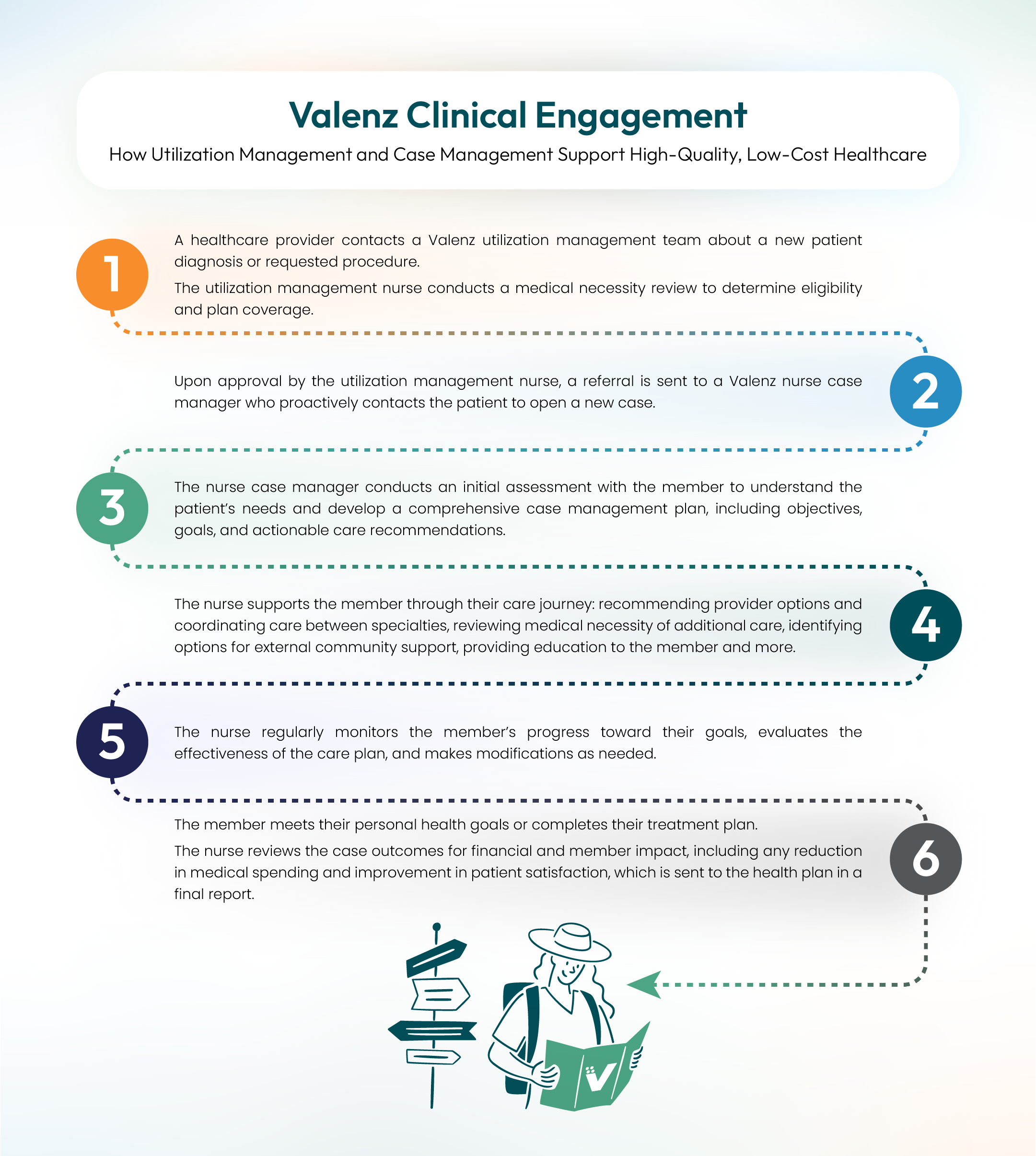
For example, case management programs like Valenz Clinical Engagement proactively identify high-cost claims early in the care journey, guiding them through expensive treatments by connecting them to high-quality, low-cost providers. Members get access to high-value care, and plans reduce unnecessary costs — a win they can leverage during stop loss renewal season.
“If a TPA or a broker/advisor is a very proactive one and knows their claims and communicates well with me throughout the year, they tend to be better groups [in terms of renewal pricing],” said Madden.
From a claims processing standpoint, Madden advises that plans invest in payment integrity tools that align with industry coding and billing standards. Programs that incorporate data analytics and AI with human review can deliver faster, more accurate cost containment in response to rising provider claim costs.
“Everybody’s trying to incorporate AI into their business model in some way, shape, or form, and providers are no different,” said Madden. “There are provider programs out there that are maximizing charges: throw everything at a wall on this patient and see what sticks with that payer.”
Integrating Stop Loss with Other Healthcare Solutions
For many years, stop loss had been viewed as an afterthought to overall health plan design. But, in the face of rising claim costs, today's health plans must consider how their health plan design actively influences their stop loss underwriting (and vice versa).
Part of the challenge, Madden explained, is the endless number of point solutions many health plans have implemented thus far as cost-containment strategies. If these solutions can't integrate with each other, they often create more confusion and frustration than results, making it difficult to prove their worth to underwriters.
“It’s hard as an underwriter to give credit for multiple pain-point solutions when there’s no real data exchange or integration between them,” said Madden. “Logically, from an underwriting standpoint, if they are all under one umbrella and they can all share data... maybe that equals a five or six percent discount.”
Recognizing the importance of that data integration, Valenz cost-containment solutions act as a connected suite, providing the proof of efficiency that stop loss carriers need for informed underwriting. All of our solutions can be accessed under the same phone number, reducing member frustration and allowing for ease of access to whatever solution is needed at the time of contact.
The exchange of plan data across member experience and payment integrity solutions allows for smarter plan design, enabling long-term cost-containment results that directly impact stop loss renewal pricing — as demonstrated in the $20,000 savings projected for one payer.

To see what savings our programs can bring to your stop loss policy, reach out to our team today. Our stop loss underwriters can evaluate your existing plan design, recommend programs to enhance your savings potential, and help you create an integrated strategy for long-term savings and better plan performance.
Get started by contacting us below.
