Back
Back
According to research by the NAIC, 84% of health insurers report they currently use artificial intelligence and machine learning in some capacity.
Among the top reasons for doing so? Fraud claim detection.
With their promise of delivering faster, more accurate claims review, AI and data analytics programs have become a staple of modern payment integrity strategies. These solutions are increasingly adopted by payers, plans, and providers to cut down on the estimated $114 billion in wasted healthcare spending in the U.S. each year.
But the future of payment integrity isn't driven by AI and analytics alone.
As the industry becomes more complex and costs continue to rise, plan payers must combine this advanced technology with clinically trained, human experts who can interpret complicated claims, adapt to evolving billing practices, and continuously improve payment integrity strategies.
In this guide, we'll dive deeper into that topic to explore how analytics and AI are impacting the current state of the payment integrity field — and how industry leaders like Vālenz Health® blend technology with human expertise to stay ahead of billing complexities and deliver higher cost containment for payer clients.
Table of Contents
- The Current State of Healthcare Analytics in Payment Integrity
- How Valenz Health Combines Data Analytics and Clinical Expertise for a Stronger Payment Integrity Strategy
- Improve Your Payment Integrity Strategy for Higher Cost Containment and Better Accuracy Today
The Current State of Healthcare Analytics in Payment Integrity
The U.S. healthcare analytics market size is estimated to reach $67.5 billion by 2033, reflecting the rapid adoption of AI and predictive analytics across the entirety of the healthcare ecosystem.
Payers are especially keen on how these tools will affect their bottom lines, with 72% of respondents in MedInsight's 2025 Payer Market Survey ranking cost and utilization analytics as the area most linked to organizational success.
Their main objective: "Improving operating margins" in the face of ever-rising healthcare costs caused by high rates of inflation, high-cost conditions, complex billing practices, and more.
Advantages of AI and Data Analytics in Payment Integrity
The usage of AI, machine learning, and data analytics in payment integrity can help achieve those goals in many ways.
When incorporated into payment integrity efforts strategically, AI and data analytics can:
- Detect patterns in large datasets faster than manual review: AI can efficiently comb through large amounts of data in a way that human auditors cannot, identifying discrepancies and patterns that data analytics programs can then make sense of.
- Identify anomalies that traditional edits and reviews may miss: In one recent study, a data analytics model achieved 92.4% accuracy in identifying potentially fraudulent healthcare providers.
- Sort and prioritize high-risk claims for review, saving time wasted on lower-priority claim review: Not all claim errors hold the same severity. When deployed together, AI and data analytics programs can quickly identify the high-risk, high-cost claims that offer maximum potential savings for payers and plans.
- Automate repetitive, low-value tasks: According to McKinsey, using AI to enable the revenue cycle could lead to a 30–60% reduction in cost to collect, allowing workforces to focus their efforts on patient value instead of administrative tasks.
- Improve program speed and scalability: When compared to manual claim review processes, automation has shown to reduce processing time by 55% with high accuracy.
Overall, incorporating analytics and automation into processes like payment integrity could eliminate $200–$360 billion in spending for the U.S. healthcare system — offering significant cost-containment opportunities for plans and their payers.
The Missing Piece: Expert Human Review
All that said, the conversation around AI and data analytics in healthcare can miss an important aspect: the necessity of human reviewers.
While they have made great advances in the last decade alone, automation and AI are not yet foolproof, especially when deploying them in healthcare. A study published in Aug. 2025 revealed that artificial intelligence-enabled medical devices with no clinical validation were more likely to be the subject of recalls. Clinician overreliance on AI can increase medical errors due to automation bias, and algorithms trained on biased historical healthcare data can unintentionally worsen health disparities.
The same concepts apply in the payment integrity space. While technology like AI and analytics can flag potential issues, only experienced claims reviewers and clinicians can determine what those issues actually mean — and the best way to address them within the scope of the organization at large.
Consider a 2024 study, in which researchers compared the effectiveness of an AI claims review system alone and in combination with human reviewers. The study concluded that the AI system performed more accurately in the latter case, illustrating the importance of human involvement in automated payment integrity processes.
In short, trained reviewers bring a level of expertise and knowledge that automated systems cannot match, especially for:
- Clinical review and medical necessity evaluation
- Changes and updates to medical coding
- Regulatory updates amidst changing laws and legislation
- Provider documentation analysis
- Nuanced and complex billing scenarios
How Vālenz Health® Combines Data Analytics and Clinical Expertise for a Stronger Payment Integrity Strategy
Relying on AI and automation alone for processes like claims reviews can expose plans and payers to real risk. That's why Valenz has developed a different approach to payment integrity that integrates AI, data analytics, and human review for stronger cost-containment — supporting overall access to higher-quality care.
This integrated approach is deployed across our entire suite of Payment Integrity solutions, following a tried-and-tested review process.
- Claims data is fed into proprietary AI systems for initial review. The programs analyze these extensive datasets to identify potential trends and patterns. All PHI-related data remains confidential and protected.
- Data analytics programs review the identified trends and patterns. Informed by our extensive claims datasets and historical knowledge, our data analytics programs prioritize identified opportunities based on potential risk.
- Clinical experts manually review high-risk opportunities. Our team of experienced claim reviewers confirm the findings identified by data analytics. They then apply their own experience (based on years in the industry) to the situations presented, creating unique plans to resolve the claims errors and maximize client savings.
- Data is fed back into the analytics program. When claims are resolved, those findings and resolutions are incorporated into our data analytics system to continually refine its analysis capabilities, supporting faster, more accurate findings in the future.
The strength of our proprietary data analytics programs comes from the extensive data that powers them, including:
- Qualified reimbursement databases
- Clinical data
- Claims data
- Cost data
Combined with coding expertise by our human reviewers, this data powers all of our payment integrity solutions (a few of which we've highlighted below) to support accurate, defensible payment decisions for our plan payer clients.
Valenz Curated Data Sources: Extensive Primary-Sourced Medical Datasets for Claims Review
Each week, more than 10,000 changes are made to federal coding and coverage rules, changes that greatly influence the entire claims review process.
Valenz Curated Data Sources keeps up with every one of those changes — so you don't have to.
By combining best-in-class datasets, medical code libraries, and medical data tables (including ICD-10-CM, ICD-10-PCS, CCI, CPPT and other datasets), our Curated Data Sources solution delivers a degree of accuracy unmatched by others to identify and prevent claim coding errors and ensure accurate reimbursements for payers.
These data libraries can be integrated with a variety of claim adjudication platforms, allowing payers and plans to quickly and easily incorporate all the latest data into existing claims processes.
Curated Data Sources also powers Valenz Clean Claim Verification, our proprietary data analytics system for medical coding review. Together, the two solutions deliver verification with unparalleled speed and accuracy to create significant savings, such as the $43.4 million in potential savings identified for one of our payer clients.
Valenz Market-Sensitive (VMS®) Repricing: Superior Repricing for Out-of-Network Claims
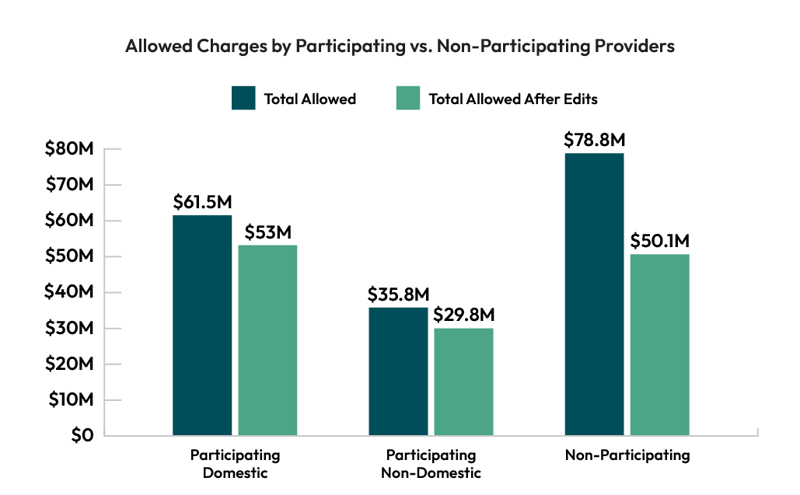
VMS repricing is our answer to the industry's traditional reference-based pricing model, one that delivers higher savings through a more comprehensive approach to repricing.
Like the rest of our payment integrity solutions, our VMS repricing methodology is powered by an extensive amount and variety of datasets, including Medicare rates, paid claim data, utilization/quality data, and more. When deployed as part of our proprietary algorithm, they provide a more detailed understanding of fair, reasonable repricing rates for providers within a certain area.
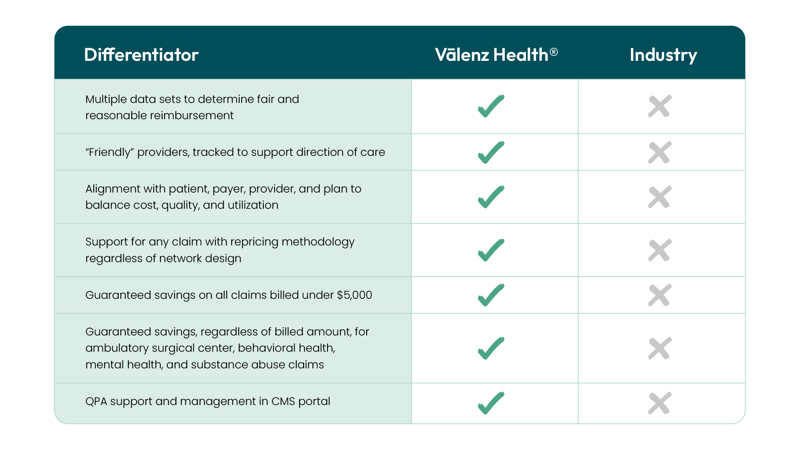
Informed by this data and the expertise of human reviewers managing every case, the VMS repricing model consistently creates higher cost containment for payers, including 70.6% average savings rate for health plans.
Valenz Bill Review: Proactively Identifying Claim Errors for Higher Savings
Our integrated approach to automation and human review is deployed to full extent in Valenz Bill Review, which delivers line-by-line validation of medical necessity, coding accuracy, and appropriateness before any payments are made.
Bill Review is, first and foremost, led by expert coders and clinicians in the medical field, who provide the full extent of bill review required for accurate processing of claims. These teams are supported by advanced data analytics and AI systems, which can be used during initial review to speed up the claims process — with any errors or findings always verified by a human coder or clinician before finalization.
With this comprehensive approach, Bill Review doesn't just create average savings of 17% above network allowable on claims with identified savings. It also minimizes provider friction and appeals by delivering a 70% average provider signoff rate and a less-than-1% provider appeal rate.
Improve Your Payment Integrity Strategy for Higher Cost Containment and Better Accuracy Today
As today's plans and payers look to improve their payment integrity strategies, AI, automation, and data analytics will top the list of "must haves" for many.
But these solutions cannot be the sole gatekeeper for claims review and processing. Instead, they must be used in tandem with human-led clinical review to ensure the highest possible accuracy, savings, and protection for all involved.
At Valenz, we are dedicated to innovating in smart, sustainable ways that best serve our clients' needs. Our Payment Integrity suite is no exception.
By combining the power of AI and data analytics systems with the unique human expertise offered by in-house coding and clinical reviewers, we help save valuable time, money, and effort for our clients, allowing them to focus on what matters: ensuring access to high-quality care for their plan members.
Learn more about our solutions — and how they work to create better cost containment for health plans — by contacting one of our team members today.