Back
Back
In an industry where providing high-quality care to patients is the utmost priority, ensuring providers are properly credentialed and meet ongoing compliance standards should be an equally critical investment for healthcare organizations.
Unfortunately, far too many organizations fail to grasp the difference between credentialing and compliance — a fatal mistake that can lead to significant financial and reputational consequences for both facilities and the providers that they employ.
To maintain the highest level of provider quality, today’s healthcare organizations must develop a multi-pronged compliance strategy: one that incorporates initial credentialing, routine recredentialing, and automated, ongoing monitoring of exclusion lists.
As an industry leader in Provider Quality solutions, Vālenz Health® understands the critical importance that a detailed compliance strategy plays in supporting smarter, better, faster healthcare. That's why we offer comprehensive, customizable credentialing/recredentialing and monitoring services that take the administrative burden off your team’s shoulders.
In this guide, learn more about what those solutions entail, why they matter, and how they work together to protect your healthcare organization and the patients that you serve.
Table of Contents
- Why Credentialing Alone Doesn’t Meet OIG Compliance Standards
- The Risks of Inadequate Exclusion Monitoring
- Provider Credentialing vs. Continuous Compliance Monitoring
- Combining Credentialing and Provider Staff Sanction Monitoring for Comprehensive Protection
Why Credentialing Alone Doesn’t Meet OIG Compliance Standards
When building their provider verification strategy, many healthcare organizations assume that credentialing and recredentialing is enough to ensure compliance with federal standards — but that’s simply not the case.
The Office of Inspector General (OIG) also requires ongoing exclusion monitoring to ensure compliance that protects patients in real time from bad actors trying to skirt the system.
Credentialing is intended as a point-in-time validation of any licenses, education, and certifications necessary for providers to be approved for network participation. Typically, credentialing is completed at the time of initial hire and repeated at regular intervals — sometimes as infrequently as once per year — based on the standards established by applicable regulatory and accrediting bodies.
Ongoing monitoring, on the other hand, is more comprehensive in nature — filling the gaps between recredentialing initiatives to ensure patients are continuously protected should any compliance risks occur.
Per OIG guidance, compliance monitoring must be conducted on at least a monthly basis (and is recommended to be ongoing in nature) to identify sanctions, exclusions, and other disciplinary actions that can ultimately harm patients. It’s designed to act as real-time reporting, allowing organizations to respond to those compliance risks right when they happen — not just when credentialing/recredentialing initiatives are deployed.
Unlike credentialing, compliance monitoring is not a once-a year, “set-it-and-forget-it" activity. It is a continuously deployed program designed to detect risks and bad actors in real time to minimize adverse effects on patient care, as well as potential financial or reputational harm to the organization.
Those healthcare organizations who rely solely on credentialing, therefore, put themselves, their providers, and their patients at significant risk — risks that are often not discovered until the damage is already done.
The Risks of Inadequate Exclusion Monitoring
The potential harms of improper compliance monitoring affect more than just providers and facilities; these risks can also ripple outward to impact patients, plan, and payers in turn.
Without continuous, comprehensive credentialing and compliance monitoring, your organization opens all these parties to the following dangers:
1. Financial and Legal Penalties
Organizations that fail to meet compliance standards are subject to significant financial and legal penalties, including civil monetary penalties, repayment of historical claims, and the loss of participation in federal healthcare programs.
These penalties can add up substantially over time. In 2024 alone, the OIG reported 1,548 criminal and civil enforcement actions, totaling more than $7.13 billion in expected recoveries and receivables. Several of these cases were worth millions in and of themselves; one enforcement action resulted in jail terms and an order to pay more than $424 million in restitution for fraudulent medical equipment sales.
2. Wasted Time and Effort by Administrative Teams
To save money, some organizations deploy manual, in-house processes to conduct exclusion monitoring of their provider lists. Unfortunately, this process quickly becomes unmanageable, especially when overworked teams conduct the monitoring in silos with one-off searches, complicated spreadsheet tracking, and no documented systems to support future audits.
These manual processes require an immense amount of time, energy, and financial investment by HR, compliance, and credentialing teams, many of whom are responsible for other critical organizational functions. As a result, compliance becomes a “checkbox” item instead of a comprehensive monitored process, increasing the likelihood of compliance risks slipping through and affecting patients with subpar care.
3. Failed Audits
It’s critical that healthcare organizations remain prepared for an audit at a moment’s notice. But, without a clear and ongoing process for credentialing and compliance monitoring, internal teams are often left scrambling to gather the necessary documents for an audit, making it difficult to prove:
- What was searched
- When it was searched
- What actions were taken
As a result, a healthcare organization is more likely to fail their audit, which, in turn, leads to the financial and reputational penalties described above.
4. Improper or Dangerous Care Delivery
At the end of the day, the compliance and credentialing process is about protecting patients from low-quality or dangerous care by ensuring an organization does not employ or contract with excluded or high-risk individual providers.
Without a comprehensive, proactive compliance strategy, organizations risk exposing their patients to care delivered by uncertified individuals — care that could erode a patient’s trust in the healthcare system and negatively affect their long-term health outcomes.
Provider Credentialing vs. Continuous Compliance Monitoring
To minimize these risks, healthcare organizations must go beyond basic credentialing and recredentialing to incorporate continuous monitoring into their compliance strategy — a process that Valenz makes easy with our customizable Provider Quality solutions.
Our solutions — Valenz Credentialing and Valenz Provider Staff Sanction Monitoring — are specifically designed to work simultaneously, delivering comprehensive protection for healthcare organizations and the patients they serve.
Credentialing takes the complex and labor-intensive challenge of verifying and maintaining provider credentials off your team’s shoulders, streamlining the process for a comprehensive approach to provider data management and compliance. Through a fully customizable platform and expert service and support from our URAC-accredited, NCQA-certified team, Valenz helps many organizations reduce credentialing timelines significantly — often from the industry average of 90 to 180 days to as few as 12-25 days, depending on scope and complexity.
Weekly electronic reporting and immediate notification of sanctions and other disciplinary/licensing concerns allow for continuous monitoring of provider credentials, filling the gaps between annual credentialing timelines for more comprehensive protection.
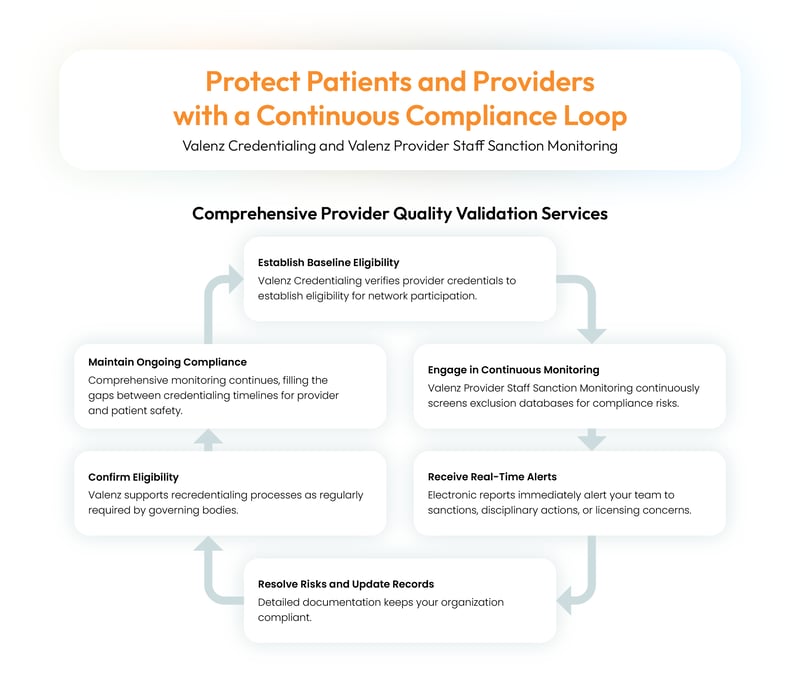
At the same time, Provider Staff Sanction Monitoring ensures your provider list stays compliant with real-time monitoring of exclusion databases from all 50 states and U.S. territories. Like our Credentialing solution, Provider Staff Sanction Monitoring is fully customizable — available in four different tiers to meet your organization’s needs, however extensive they may be.
With its deep-search capabilities, our solution delivers improved accuracy and the ability to conduct single and batch searches, as well as annual and ad hoc checks. Clear documentation of each search aligns with OIG best practices, ensuring that your organization is always ready for an audit, whenever it may occur.
Together, these solutions support a closed-loop provider quality validation system: establishing baseline eligibility through routine Credentialing checks and ensuring ongoing compliance with continuous monitoring through Provider Staff Sanction Monitoring.
As a result, Valenz clients get comprehensive protection that other industry solutions do not provide — minimizing the risks of noncompliance and supporting smarter, better, faster healthcare for patients with high-quality provider lists.
Combining Credentialing and Provider Staff Sanction Monitoring for Comprehensive Protection
In short, while credentialing validation services are critical for maintaining provider quality, they often leave a huge risk-management gap for healthcare organizations — a gap that can only be filled with continuous compliance monitoring services.
The Provider Quality solutions from Valenz minimize those risks by offering ongoing, real-time provider verification and validation support, protecting organizations like yours from significant financial, legal, and reputational harm.
In combining both Credentialing and Provider Staff Sanction Monitoring, Valenz provides an integrated approach that monitors provider compliance throughout the year to provide comprehensive risk protection, enhanced by:
- A strong combination of advanced technology and service provided by experts in their field
- A customizable compliance model, offering everything from fully managed support to self-service options
- Flexibility in database coverage, allowing the incorporation of additional data sources for more thorough coverage
- Cost-effective pricing that takes your organization needs into account
Ensure continuous protection for your healthcare organization — and protect your patients’ access to high-quality, safe care options — by designing a custom compliance and credentialing strategy with Valenz today.
Contact our team below to get started.