Back
Back-1.jpeg?width=375&height=375&name=AdobeStock_600720024%20(1)-1.jpeg)
For the second year in a row, healthcare costs are expected to rise by 9% for the group market in the United States, according to the latest research by PWC.
Most of those expenses can be traced back to hospital and physician care, which made up more than half of total health expenditures in 2023. Notably, spending on prescription drugs and hospital care rose by 11.4% and 10.4%, respectively, which spending on physician services and clinical services increased by 7.6% and 7.0% in the same time frame.
But what exactly are the health conditions driving this spend — and how can employers and health plans help members manage these conditions to minimize costs over time?
As the platform to simplify healthcare, Vālenz Health® works with thousands of employers across the U.S. to proactively manage member and plan healthcare spend. Today, we’ll explore a few of the conditions we see impacting members the most — and the innovative solutions we offer to reduce those costs while protecting access to high-value care for those who need it most.
Table of Contents
- Top Conditions Responsible for Rising Healthcare Costs in the U.S.
- How Health Plans Can Manage these Conditions — and Associated Costs — with Proactive Solutions
- Control Your Plan’s Healthcare Costs with Vālenz Health® Today
Top Conditions Responsible for Rising Healthcare Costs in the U.S.
In general, Americans utilize healthcare services at a much higher rate — and at a much higher price — than other developed countries. While there are many contributing factors for this increase in utilization, the prevalence of serious, costly conditions across the general population plays a significant role.
For both employers and employees, most healthcare costs stem from a few categories of medical conditions with long-lasting health and financial effects:
Chronic Diseases
According to Fair Health, nearly 58% of commercially insured patients had at least one chronic condition in 2024. The costs of these conditions are significant; those patients with just one chronic condition incur an average of $3,040 in allowed medical expenses per year, compared to the $1,590 in average expenses for those without chronic conditions.
For those with 10 or more chronic conditions, the cost is staggering — an average of $21,730 per year.
While chronic conditions as a whole are responsible for 90% of the nation’s $5.3 trillion in annual healthcare expenses, a few of those conditions cause an outsized effect on industry spending:
- Heart disease and stroke: According to the CDC, more than 850,000 Americans died of heart disease or stroke in 2024, making it the leading cost of death that year. Costs from cardiovascular diseases are projected to hit roughly $2 trillion by 2050.
- Diabetes: The CDC estimates that more than 40.1 million Americans have diabetes, and other 115.2 million have prediabetes. In 2022, the total estimated cost of diagnosed diabetes was $640 billion in medical costs and lost productivity.
- Obesity: A growing number of Americans are classified as obese, a condition that costs the U.S. healthcare system nearly $261 billion a year. Those costs are compounded by the popularity of expensive weight-loss medications (GLP-1s), for which annual spending could exceed $100 billion annually within the next five years.
- Alzheimer’s disease: Nearly 7 million Americans have Alzheimer’s, and deaths due to this disease have more than doubled between 2000 and 2021. The Alzheimer’s Association estimated the total cost of care for those with this condition would reach $384 billion in 2025.
Cancer
While cancer is also considered a chronic condition, its financial impact on both plan payers and plan members warrants its own recognition in this list.
While new oncology drugs, immunotherapies, clinical trials, and advanced treatments have made great strides in cancer survival rates, they’ve also driven up costs for payers and patients. The NIHCM Foundation estimates the national cost of cancer care in the U.S. will grow to $246 billion in 2030, in part because the list price for many prescription medications is more than $100,000 annually.
The American Cancer Society reports that patients are estimated to pay $21.1 billion in cancer-related costs each year, including $16.2 billion in total out-of-pocket costs. Cancer is also the most common medical condition for high-cost stop loss claims for employers, accounting for $564.2 million in reimbursements in Sun Life’s annual report.
Behavioral Health
Once considered a supplementary benefit offering, behavioral health services are now covered by 97% of employers. As a result, more employees are receiving the mental health support they need, with PWC reporting a 62.6% rise in utilization of behavioral health services claims between 2018 and 2024.
That increase comes with a cost. Employers pay nearly $200 billion every year in mental healthcare costs, and employee poor mental health costs employers an average of $1,488 per employee each year through healthcare spending, lost work time, and turnover.
(All that said, behavioral health benefits can actually deliver significant savings over the long term, such as the net savings of $159 per member per month and 1.8 program ROI revealed a 2025 study.)
Musculoskeletal Conditions
Musculoskeletal conditions — such as arthritis, joint disease, and osteoporosis — are frequently ranked by 75% of employers among the top two health conditions driving their overall plan costs.
Each year, these conditions generate approximately $381 billion in medical expenses and represent nearly 15% of employer medical spending. That doesn’t even include the non-healthcare costs for employers, such as missed workdays and productivity loss.
And, with cases of arthritis and osteoporosis expected to rise by more than 30% in the next 20 years, the financial burden on payers and members will increase, too.
How Health Plans Can Manage these Conditions — and Associated Costs — with Proactive Solutions
As employers and plan sponsors stare down the costs associated with these increasingly prevalent and serious chronic conditions, the answer will not be found in strategies that attempt to reduce utilization or pass costs along to members.
Instead, today’s health plans need to take a more proactive, member-focused approach — one that encourages smarter, more cost-efficient care choices that support long-term employee health.
As part of our commitment to support strong, vigorous, and healthy lives, Valenz has innovated solutions to do just that.
Below, learn how we help employers — and the brokers, TPAs, and consultants who support them — take a smarter approach to health plan design that minimizes costs while protecting employees’ access to high-value care options.
Healthcare Navigation
The healthcare industry is confusing, and many members don’t know how to make the best choices for their health and their wallets.
Healthcare navigation services fill that gap, providing the knowledge and professional guidance members need to make smarter decisions.
Take Valenz Clinical Engagement, for example. As our comprehensive care management suite, Clinical Engagement engages early and often with high-risk members to influence care decisions before costs escalate.
Through Case Management, members are connected to nurse case managers who can help them create a treatment plan — answering their questions, recommending high-value providers, and acting as member advocates.
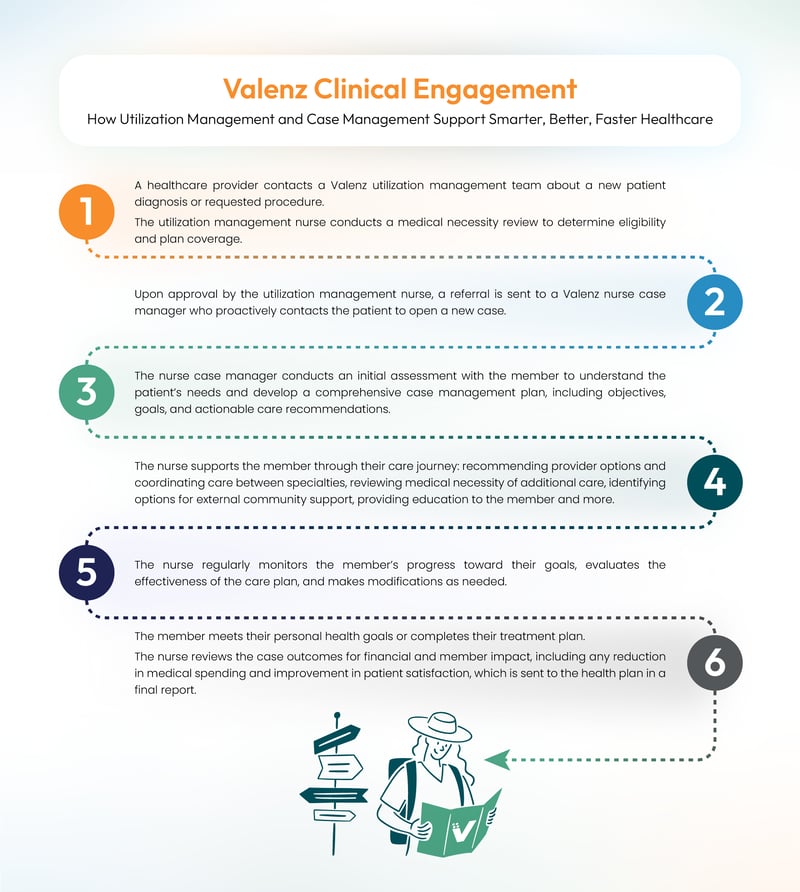
Our Disease Management feature is designed specifically for members with chronic conditions to avoid high-cost claims over time. By combining ongoing, personalized coaching with the tools that members need for successful self-management, we help to prevent and manage the effects of chronic illness — as well as the resulting costs.
Research shows that more than 40% of all cancers are related to modifiable risk factors over an individual’s lifetime, including obesity, tobacco use, alcohol consumption, and poor diet and physical activity. Ongoing engagement with members through case management solutions can help address those risk factors early on, guiding members toward smarter lifestyle choices that can deliver better care outcomes and lower total healthcare costs over the long term.
Specialty Drug Programs
For many people with chronic health conditions, the costs of their prescriptions can be a serious financial burden.
According to a KFF report, six in 10 adults say they’re worried about affording their prescriptions, the highest number reported since 2018. Even more worrisome: Four in 10 say they have taken cost-saving measures (skipping doses, not filling prescriptions, etc.) to avoid those expenses — decisions that can cause long-term negative health effects.
Pharmacy savings programs like Valenz Bluebook Rx can help alleviate this financial burden to ensure continued member access to (and adherence with) the medication they need.
As a comprehensive pharmacy cost and benefits management solution, Valenz Bluebook Rx reviews claims data to identify where overpriced prescriptions are being used by members. Then, the program delivers a personalized savings report to members with recommendations for clinically equivalent, lower-cost alternatives — offering smarter, more affordable prescriptions to minimize both out-of-pocket and overall plan costs.
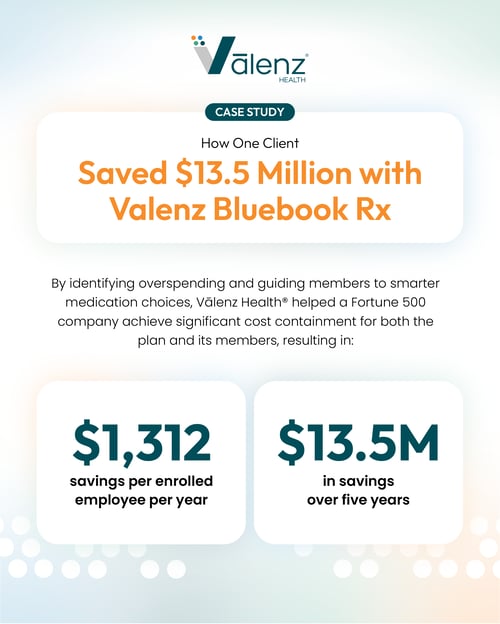
The GLP-1 Savings Strategy Program offers additional savings for popular but expensive weight loss medications, which are used by people with obesity, diabetes, and other chronic conditions. Through a comprehensive cost-containment approach, our program reduces the $1,000-per-month average GLP-1 cost to a more affordable price for plan members.
Surgical, Imaging, and Infusion Solutions
Orthopedic, spinal, cardiovascular, and cancer surgeries are consistently among the most expensive claims for employer-sponsored health plans — but there are solutions to minimize the financial cost of these procedures.
As part of the Valenz Precision Care suite, our Surgical and Imaging bundles solution connects members to high-value, cost-effective providers and facilities for necessary procedures. Our national direct contracting network allows for average savings of 50% or more for plans, with members paying $0 out-of-pocket while receiving support from a nurse case manager.
At the same time, our Infusion Therapy solution helps members secure access to important infusions (such as chemotherapy, enzyme replacement therapies, and iron infusions) at outpatient centers or at home. This way, members get the lifesaving therapies they need at a lower cost, supporting higher cost containment and better treatment adherence over time.
Control Your Plan’s Healthcare Costs with Vālenz Health® Today
The prevalence of serious chronic diseases and the expensive landscape of today’s healthcare industry pose an urgent challenge for employers: adopt proactive cost-containment solutions now or risk even higher expenses in the years to come.
Fortunately, Valenz makes that strategy shift easy through an integrated, comprehensive solution suite built with the member in mind.
By engaging early and often with health plan members, our Member Experience solutions support access to high-value healthcare through cost transparency, guided care navigation, direct contracting networks, and much more.
Explore its potential for your health plan — and see how much it can save you and your members on healthcare costs — by contacting one of our team members today.