Back
Back
Despite the fact that 1 in 31 children in the United States are diagnosed with autism, finding the right support can often feel overwhelming for families navigating a child’s diagnosis.
Early intervention and effective treatment approaches are key to helping children develop essential life skills. One widely used and research-backed method is applied behavior analysis (ABA), which focuses on reinforcing positive behaviors and reducing symptoms that interfere with quality of life and daily function.
Below, learn more about:
- What ABA is and how it works to support children with autism
- How families can choose the right therapy solutions for their children’s needs
- How Vālenz Health® helps support families in securing access to this critical care
What Is Applied Behavior Analysis?
Applied behavior analysis is a treatment that supports children with autism by reinforcing positive behaviors and reducing negative ones, which can improve communication, social interaction, and daily living skills. (Note: While this guide will focus on how ABA can support children with autism, it can be an effective approach for adults, too.)
During ABA therapy, clinicians develop an individualized plan based on the child’s needs, often breaking complex skills down into smaller, more manageable steps and rewarding progress along the way. This teaches the child new behaviors by providing positive reinforcement when they perform the desired action.
For example, if a child has trouble playing with other children, an ABA therapist may encourage making eye contact and taking turns during play sessions, and, when a child performs those behaviors, rewarding them through praise or a small reward. If a child is struggling to ask for what they want, a therapist may break the task into smaller steps, such as pointing to the desired item, encouraging the child to use a single word for the item they desire (for example, “ball”), and then immediately positively reinforcing each attempt.
Each child’s program is tailored to their unique needs and goals, as well as their strengths and challenges. Rather than using punishment for negative behaviors, applied behavior analysis focuses on the positives by rewarding desired behaviors. The program uses a data-driven approach to evaluate the effectiveness of interventions and adjust strategies as needed.
How Applied Behavior Analysis Supports Children with Autism
By focusing on a child’s strengths and skills, applied behavior analysis strategies prioritize improving existing skills or teaching new skills rather than simply reducing challenging behaviors.
While ABA can support many valuable skills, learning plans typically are built around the following focus areas:
- Communication Skills: To improve verbal and nonverbal communication among those with autism, ABA therapists use strategies that teach receptive language (comprehending what is said or written), expressive language (using words to communicate), and appropriate social interactions.
- Social Skills: Social skills strategies aim to enhance social interaction abilities by teaching a child ways to initiate conversations, follow social cues, and engage in reciprocal play.
- Adaptive Skills: Adaptive skill support strategies focus on daily living skills, such as developing and following self-care routines, dressing properly, maintaining personal hygiene, and eating independently.
- Behavioral Management: Behavioral management strategies focus on reducing challenging behaviors, such as tantrums or aggression, through positive reinforcement. Like with all applied behavior analysis, this is done through positive reinforcement of desired behavior rather than punishment of unwanted behavior.
Common Applied Behavior Analysis Strategies
While all ABA therapy focuses on positive reinforcement strategies, it can be deployed in several different ways, depending on the child involved and the goals of the therapist:
Discrete Trial Training (DTT)
This is a structured teaching method where step-by-step instructions are used to teach the desired response or behavior. DTT is broken down into its simplest parts for children to respond to. Desired responses are rewarded, while undesired behaviors and responses are ignored.
Pivotal Response Treatment (PRT)
PRT takes place in a natural setting instead of a clinic. The purpose of this strategy is to focus on teaching "pivotal" foundational skills — for example, the ability to communicate with others — that will, in turn, help the child learn more social skills over time.
If a child with autism struggles with initiating communication and becomes frustrated when they can’t express their needs, PRT can be used in the child’s home and on the playground to encourage spontaneous communication in a non-clinical setting.
Visual Aids
Applied behavior analysis uses visual aids, such as symbols, pictures, and other objects, to enhance understanding and communication. This strategy provides a clear representation of a task or routine, helping children express their needs and navigate their environment better.
What Families Should Consider When Seeking ABA Therapy
Before choosing a therapist and enrolling a child in ABA therapy, families should consider the following:
- Patient age: Early intervention and diagnosis are critical for those with autism. Research shows that diagnosing autism and implementing ABA therapy early in a child’s life can result in long-term positive impacts on current symptoms and later skill development.
- Qualified professionals: Applied behavior analysis should be provided by a board-certified behavior analyst (BCBA) who can design and implement a personalized program tailored to a child’s needs, preferences, and interests.
- Collaboration style: Effective applied behavior analysis requires strong collaboration between therapists, parents, and caregivers to ensure consistency across environments.
How to Find Applied Behavior Analysis Facilities with Care Navigation Tools
Finding the right BCBA for ABA therapy can be a long process. In fact, families often meet several different providers before enrolling their child — and may even begin therapy at several different clinics before finding the right one for their child’s needs.
Families can minimize time spent researching with quality navigation tools, such as the Valenz Bluebook price and quality transparency solution. With this platform, members can research facilities that offer applied behavior analysis, provide care at a fair price, and are covered under their healthcare insurance plan.
Valenz Bluebook goes a step further than most tools by color-coding options based on the quality of care and cost of care provided. Those facilities that deliver the highest-quality care at a lower price are presented with green labels, making it easy for families to secure trusted care for their child’s needs. And, thanks to a provider database fed by multiple objective data sources, parents can rest assured that provider scores are unbiased and present an accurate picture of care outcomes and provider performance.
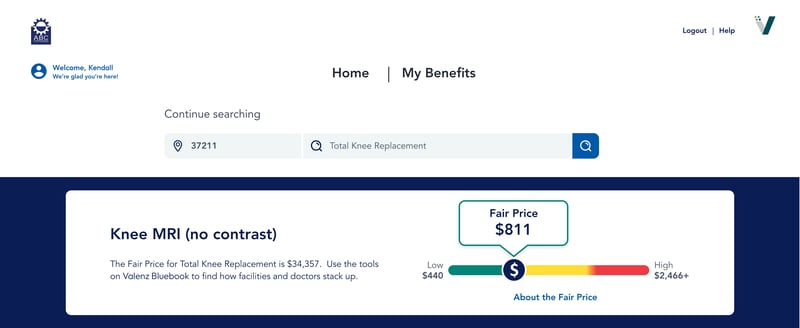 The Valenz Bluebook tool designates a Fair Price to every procedure, highlighting those providers who deliver high-quality care at a lower cost.
Valenz Bluebook is available through many major employers as a health benefits offering; contact your HR representative today to learn if it’s an option for your family.
Interested in adding Valenz Bluebook to your employee benefits program? Contact our team below to learn more about our price and quality transparency, including how it can help employees find high-quality, affordable BCBAs and ABA facilities that support strong, vigorous, and healthy lives.